5 Trade Show Lead Capture Mistakes Costing Your Sales Team Thousands
The ₹5 Lakh Trade Show That Generated Nothing
You booked the booth. You flew the team. You set up the display. You printed the brochures. Two days of conversations, demonstrations, and card exchanges. Total investment: ₹5 lakhs or more.
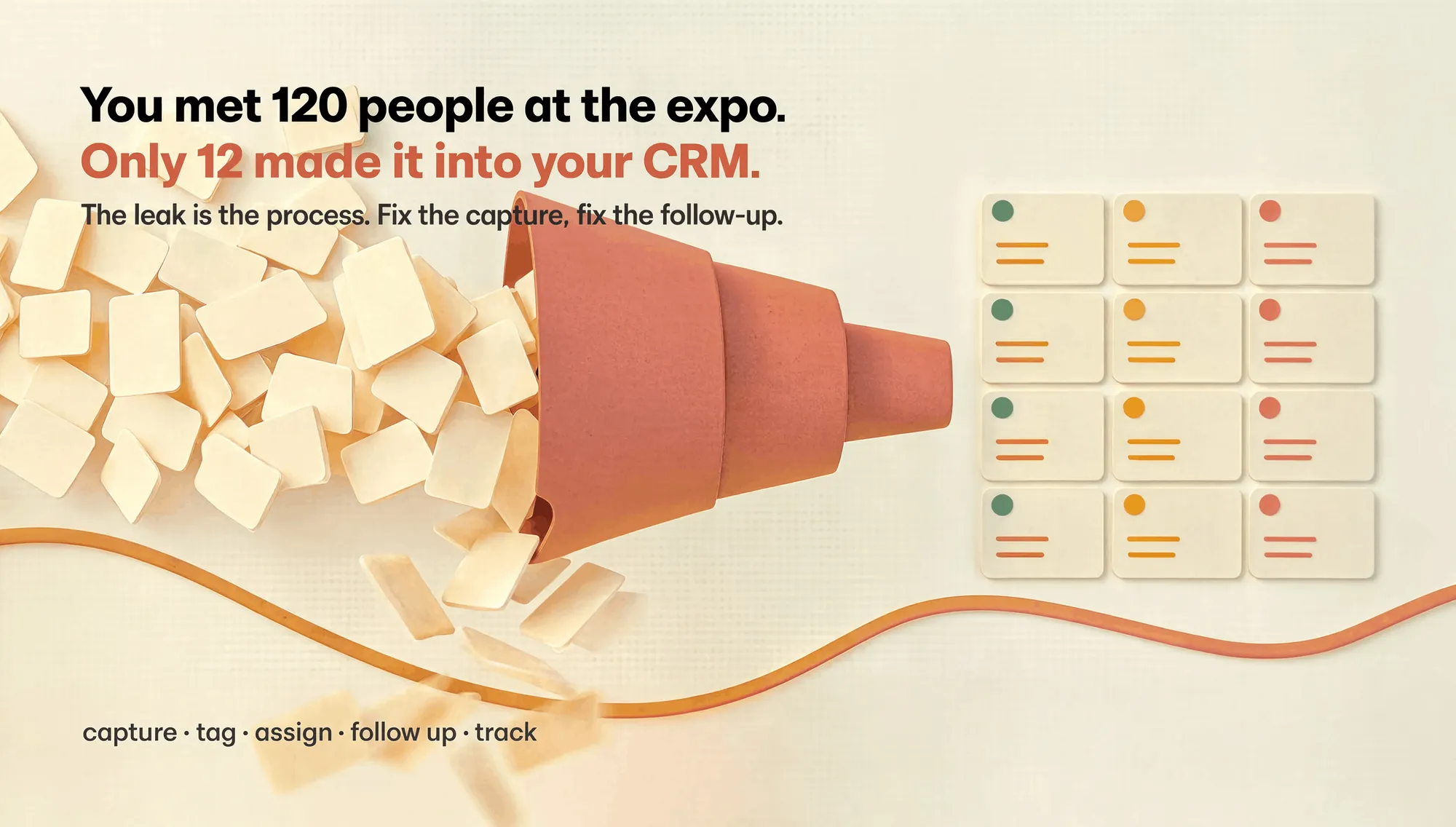
And then? The stack of 200 business cards sat on the sales manager's desk for three weeks. Nobody followed up. The leads went cold. The contacts got scattered across individual phones and notebooks. And the ₹5 lakh investment produced exactly zero pipeline.
This scenario plays out at trade shows across India every single week. The problem isn't the leads — it's the system (or lack of one) for capturing and acting on them.
Based on our work with sales teams at events like IIJS, Acetech, India Manufacturing Show, and dozens of industry-specific exhibitions, here are the five most costly lead capture mistakes — and how to fix them.
Mistake #1: Relying on Paper Business Cards
The Problem
The romantic notion of "I'll just collect cards and enter them later" is the single biggest lead killer in trade shows. Here's what actually happens:
- Day 1 of the event: You collect 60 cards. You're energized. "I'll enter these tonight."
- Night 1: You're exhausted after dinner with prospects. You enter 15 cards.
- Day 2: You collect 80 more cards. Now you have 125 unreconciled cards.
- Day 3: The stack grows to 200+ cards. You enter another 20.
- Week 1 back at office: The stack is now on your desk, competing with regular work.
- Week 2: Someone moves the stack. Cards get lost.
- Week 3: You find the stack, but now you can't remember who was who. Was "Rajesh from XYZ" the hot lead or the one who just wanted a brochure?
The cost: A study by the Center for Exhibition Industry Research found that 80% of trade show leads are never followed up. At an average cost per lead of ₹2,500 (booth cost, travel, time), a 200-card show represents ₹5,00,000 in potential value — with ₹4,00,000 of that lost to poor follow-up.
The Fix
Scan cards the moment you receive them. Not at the end of the day — right there at the booth. With an offline scanner like Kauntech, this takes 30 seconds per card. The data is digitized, structured, and ready for follow-up before you've even handed the card back.
Pro tip: Add notes while the conversation is fresh. "Wants a demo next week," "Budget approved," "Competitor user looking to switch" — capture this context immediately.
Mistake #2: No Lead Qualification at the Booth
The Problem
Not all business cards are equal. A card from a decision-maker at a Fortune 500 company who's actively looking for your solution is worth 100x more than a card from an intern who just wanted a free pen.
The mistake? Treating every card the same.
When your sales team collects 200 cards without qualifying them, they return to the office with an undifferentiated pile. The hot lead who was ready to buy gets a generic email three weeks later. The cold lead who was just curious gets a high-effort sales call. Everyone loses.
The Fix
Implement a simple lead scoring system at the booth:
- Hot Lead (Score: 3): Decision-maker with budget, specific pain point, and timeline. Follow up within 24 hours.
- Warm Lead (Score: 2): Influencer or potential user who showed genuine interest. Follow up within 72 hours.
- Cold Lead (Score: 1): General interest, brochure collector, student. Add to newsletter list.
With an AI-enabled scanner, you can even tag leads at the point of capture. In Kauntech, you can add lead scores, notes, and category tags right when you scan the card — so your team knows exactly who to prioritize when they get back to the office.
Mistake #3: Disconnected Follow-Up Systems
The Problem
This is the chaos scenario that plays out at most trade shows:
- Rajesh from sales scans cards on his personal phone using a generic scanner app
- Priya from marketing collects cards in a notebook
- Amit from product demos takes photos of cards on his camera
- The sales manager gets a WhatsApp forward of 50 screenshots
When teams don't have a unified system, leads fall through the cracks. Duplicates get created. Follow-ups get missed. And nobody has visibility into the full pipeline from a single event.
Real example: A Bangalore-based SaaS company spent ₹8 lakhs on a booth at a major tech conference. Three different team members collected cards on three different platforms. When the marketing manager tried to compile the leads, they found:
- 40% of cards were never digitized
- 25% had been entered twice by different team members
- 15% had incorrect contact information (smudged, misread)
- Only 20% were usable — and none had follow-up context
The Fix
Use a single, team-shareable scanning platform for every event. Every team member scans through the same system, and all contacts flow into a centralized view. You should be able to:
- See who collected which lead
- Know which leads are hot vs. cold
- Automatically route leads to the right CRM pipeline
- Track follow-up status in real-time
With Kauntech's multi-user capabilities, every team member scans into a shared pool. Leads can be assigned, tagged, and routed automatically to your CRM or WhatsApp — no spreadsheets required.
Mistake #4: Waiting Too Long to Follow Up
The Problem
You know the statistics: leads contacted within 5 minutes of a trade show interaction are 9x more likely to convert. But here's what actually happens at most Indian trade shows:
- Same day: You're too busy scanning and talking to follow up
- Next day: You're travelling back or attending another day
- Day 3-5: You're catching up on missed work
- Week 2: You finally start sending follow-up emails
By then, the prospect has met 15 other vendors and received follow-ups from at least 3 of them. Your window has closed.
The Fix
Automate your first follow-up touchpoint. Here's a workflow that works:
- Scan the card at the booth (30 seconds)
- AI enriches the contact with company info and context (on-device, instant)
- AI generates a personalized follow-up message based on your conversation
- The message is queued for WhatsApp or email — send it the same evening or next morning
With Kauntech, you can set up auto-follow-up sequences that trigger the moment you scan a card. Imagine: you scan a card at 3 PM. At 7 PM, the prospect receives a personalized WhatsApp message from you referencing your conversation. They respond while the memory of your meeting is still fresh.
That's the difference between a cold follow-up weeks later and a warm conversation the same day.
Mistake #5: Not Measuring Event ROI
The Problem
Most companies spend lakhs on trade show participation but can't answer basic questions:
- How many qualified leads did we generate?
- What was the cost per lead?
- How many of those leads converted to opportunities?
- What was the total revenue attributed to this event?
- Which team member captured the most high-quality leads?
Without measurement, every trade show becomes a leap of faith. You feel busy, you collect cards, you send emails — but you never know if the investment was worth it.
The Fix
Track everything from scan to closed deal. A proper lead capture system should give you:
| Metric | What to Track | Why It Matters |
|---|---|---|
| Cards scanned | Total volume | Baseline activity |
| Qualified leads | Hot + Warm | Quality of engagement |
| Cost per lead | Total event cost ÷ qualified leads | ROI calculation |
| Follow-up rate | % of leads contacted within 48 hours | Sales discipline |
| Conversion rate | % of leads that become opportunities | Pipeline health |
| Revenue attributed | Closed deals from event contacts | True ROI |
With an integrated scanning + CRM system, these metrics become automatic. Every scan is tracked, every follow-up is logged, and every deal can be traced back to the booth conversation that started it.
The Cost of Getting It Right vs. Getting It Wrong
Let's put real numbers to this. For a mid-sized trade show:
Without a proper system:
- Booth investment: ₹5,00,000
- Cards collected: 200
- Leads actually followed up: 40 (20%)
- Opportunities created: 8
- Deals closed: 2
- Revenue generated: ₹3,00,000
- Event ROI: Negative (-₹2,00,000)
With a proper system:
- Booth investment: ₹5,00,000
- Cards collected: 200
- Leads qualified at booth: 60 hot, 80 warm, 60 cold
- Leads followed up within 48 hours: 140 (70%)
- Opportunities created: 28
- Deals closed: 7
- Revenue generated: ₹10,50,000
- Event ROI: Positive (+₹5,50,000)
The system doesn't just improve results — it transforms trade shows from cost centers to revenue drivers.
The Bottom Line
Trade shows are expensive. Making the most of them doesn't require a bigger booth or more swag — it requires a better system for capturing, qualifying, and acting on the leads you generate.
The five mistakes we've covered are fixable. With the right tools and processes, you can ensure that every card you collect becomes a real opportunity, every follow-up is timely and personalized, and every trade show investment delivers measurable returns.
Stop collecting cards. Start capturing opportunities.