You Scanned 200 Business Cards at the Trade Show. AI Lead Scoring Tells You Which 20 to Call First.
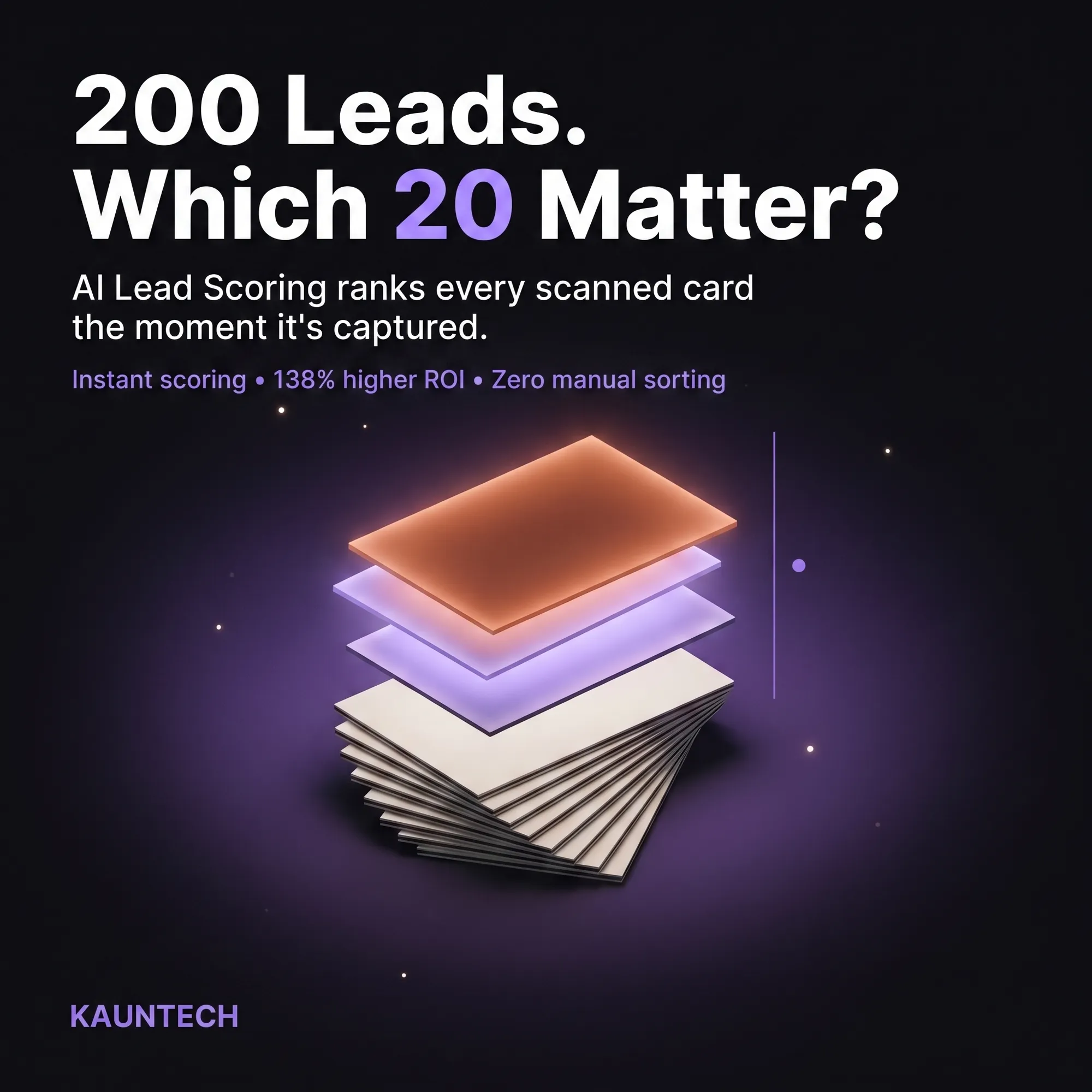
75% of B2B companies will use AI lead scoring by the end of 2026, and it lifts sales ROI from 78% to 138%. Here's how Kauntech's Lead Scoring turns a pile of scanned cards into a ranked call list — and the questions people actually ask before trusting it.
A trade show ends. You scanned 200 business cards over three days. Your sales team now has 200 names, 200 companies, and exactly zero idea which ones are worth calling first.
By the time anyone works through the pile in order, the hottest lead already bought from a competitor who called within the hour.
This isn't a hypothetical — it's the single most common failure point after the "capture" problem is solved. We've written before about the 5 mistakes costing your sales team thousands at trade shows and about WhatsApp auto-follow-up so no lead goes cold. But capturing the lead and following up with it both assume you know which lead to prioritize first. Most teams don't.
That's what AI Lead Scoring solves — and it's one of the most-used features in Kauntech that we've never actually written about. Here's how it works, the real numbers behind it, and the questions worth asking before you trust any scoring system with your pipeline.
The Problem With Manual Lead Sorting
Qualifying a single lead manually — checking the company, sizing up the role, deciding urgency — takes a sales rep roughly 20 minutes when done properly. Across 200 leads from one event, that's over 60 hours of pure sorting work before a single sales call happens.
In practice, nobody does this properly. Reps eyeball job titles, guess at company size, and call whoever they remember most vividly from the show floor. The actual best-fit lead — the one who asked three specific questions about pricing and timeline — gets buried under a stack of business cards from people who were just being polite.
What AI Lead Scoring Actually Does
Kauntech's Lead Scoring analyzes every card the moment it's scanned and ranks it by conversion likelihood — instantly, not after a rep gets around to it.
It combines three signal types, because relying on just one produces weak results:
- Firmographic signals — company size, industry, role seniority pulled from the card and enriched via Company Intelligence (founders, industry classification, headcount).
- Behavioral/intent signals — how the conversation happened: did they ask about pricing, timeline, or a specific use case? Was this a scheduled meeting or a passing booth visit?
- Engagement signals — did they scan your QR code back, save your contact via NFC tap, or reply to the first WhatsApp follow-up message?
2026 industry data confirms this combined approach matters: scoring that blends firmographic, technographic, and intent data outperforms behavioral-only scoring by 30–50% in B2B contexts.
The Numbers That Justify Using It
- Companies using lead scoring see 138% ROI, compared to 78% ROI without it — nearly double.
- The predictive lead-scoring market grew from $1.4 billion in 2020 to $5.6 billion in 2025.
- 75% of B2B companies are projected to adopt AI-driven scoring by the end of 2026 — this is now mainstream infrastructure, not an experimental add-on.
- Speed-to-lead remains the single most predictive factor in close rates — scoring exists specifically to make sure your fastest response goes to your best-fit lead, not a random one.
Where Lead Scoring Fits in the Kauntech Workflow
- Scan the card (offline, on-device, DPDP-compliant — no data ever leaves the device unencrypted).
- Enrich automatically via Company Intelligence — founders, industry, size.
- Score the lead instantly against your ICP and the conversation context.
- Route the top-scored leads straight to WhatsApp for an AI-drafted Icebreaker or Email Opener follow-up — before the trade show floor has even cleared.
- Sync everything to Google Sheets or your CRM via webhook, ranked and ready.
The scanning, the scoring, and the follow-up aren't three separate tools stitched together after the fact — they're one motion.
What Lead Scoring Cannot Do
Two honest limitations, because a scoring tool oversold is a scoring tool distrusted:
- It does not fix a loose Ideal Customer Profile. If your ICP definition is too broad, the system will confidently rank "high probability" leads that are still the wrong fit. Scoring amplifies whatever definition you feed it.
- It does not replace human judgment on timing and context. A rep still needs to read the specific trigger — what the prospect actually said — before making the call. Scoring tells you who to call first; it doesn't write the call for you.
- It needs a baseline to be genuinely predictive. Predictive scoring becomes meaningfully accurate once you're processing roughly 100+ leads a month with some deal history behind it. Below that volume, the system is directionally useful but won't yet show its full accuracy.
The Bottom Line
The gap between "captured a lead" and "closed a lead" is prioritization. Most sales teams lose leads not because they failed to collect them, but because they called the wrong ones first, or too late.
If you scanned it with Kauntech, it's already scored the moment it lands in your pipeline — no separate tool, no manual sorting, no 60 hours lost per event.
Frequently asked questions
What is AI lead scoring and how does it work?
AI lead scoring uses machine learning to predict how likely a captured lead is to convert into a paying customer. Instead of a sales rep manually judging each contact, the system analyzes firmographic data (company size, industry, role), behavioral signals (what was discussed, what actions the lead took), and engagement signals (replies, QR scans, follow-up responses) to instantly rank leads by conversion likelihood.
Does AI lead scoring actually improve sales results?
Yes. Companies using lead scoring report 138% ROI compared to 78% ROI without it. The predictive lead-scoring market grew from 1.4 billion dollars in 2020 to 5.6 billion dollars in 2025, and roughly 75% of B2B companies are projected to adopt AI-driven scoring by the end of 2026, making it standard sales infrastructure rather than an experimental feature.
How long does it take to qualify a lead manually versus with AI scoring?
Qualifying a single lead manually typically takes about 20 minutes when done properly, since a rep has to check the company, assess the role, and judge urgency by hand. Across 200 leads from a single trade show, that adds up to over 60 hours of sorting work. AI scoring performs this same evaluation instantly at the moment the lead is captured.
What happens after a lead is scored in Kauntech?
Once a business card is scanned, Kauntech enriches it automatically with company intelligence such as founders and industry classification, scores it instantly, and can route the highest-scoring leads directly to a WhatsApp follow-up with an AI-drafted icebreaker or email opener. Everything syncs to Google Sheets or a connected CRM via webhook, already ranked by priority.
Why do leads from trade shows specifically need scoring?
A single trade show can generate hundreds of scanned contacts within a few days, far more than a sales team can qualify manually before the opportunity window closes. Speed-to-lead is the strongest predictor of close rates, so without instant scoring, the best-fit lead often gets called last, after a faster-moving competitor has already reached them.
Is my scanned business card data safe when it gets scored and enriched?
Yes. Kauntech's core architecture keeps all sensitive contact data encrypted on-device with on-device OCR, in line with DPDP Act 2023 requirements. Scoring and enrichment work with this same privacy-first design, and data only syncs to the cloud or a connected CRM once network connectivity is available and the sync is triggered.